Does "DNA" really say much about Design?
Dr. Stephen Meyer reviews this topic in his best-selling book Signature in the Cell:
How complex is a cell and DNA?
When Darwin wrote his theories of evolution in the mid-1800’s the cell was a mystery. It was not until after WW II and the discovery electron microscopy, that new sub-cellular structures were discovered. Michele J. Behe, author of Darwin’s Black Box, writes;
This level of discovery (of sub-cellular structures) began to allow biologist to approach the greatest black box of all. The question of how life works was not one Darwin or his contemporaries could answer. They knew that eyes were for seeing—but how, exactly do they see? How does the blood clot? How does the body fight disease? The complex structures revealed by the electron microscope were themselves made of smaller components. What were those components? What did they look like? How did they work?[7]
To understand the complexity of a cell, Michael Denton, illustrates if a cell magnified a 1000 million times until its 20 kilometers in diameter what would we see. He writes, 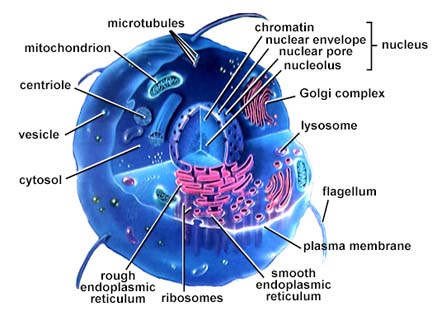
What we would then see would be an object of unparalleled complexity and adaptive design. On the surface of the cell, we would see millions of openings, like the portholes of a vast space ship, opening and closing to allow a continual stream of materials to flow in and out. If we were to enter one of these openings, we would find ourselves in a world of supreme technology and bewildering complexity. We would see endless highly organized corridors and conduits branching in every direction away from the perimeter of the cell, some leading to the central memory bank in the nucleus and others to assembly plants and processing units. The nucleus itself would be a vast spherical chamber more then a kilometer in diameter, resembling a geodesic dome inside of which we could see, all neatly stacked together in ordered arrays, and raw materials would shuttle along all the manifold conduits in a highly ordered fashion to and from various assembly plants in the outer regions of the cell… Is it really credible that random processes could have constructed a reality, the smallest element of which…a functional protein or gene—is complex beyond our own creative capacities, a reality which is the very antithesis of chance, which excels in every sense anything produced by the intelligence of man[8]
How could the first cell come into existence? Was it time, chance and matter? On the other hand, was it the result of an intelligent designer, a “First Cause” of life? Darwin wrote,
If it could be demonstrated that any complex organ existed, which could not possibly have been formed by numerous, successive, slight modifications, my theory would absolutely break down.[9]
According to Darwin’s criteria, his whole model of life falls apart. The cell is the smallest unit of matter considered alive…less than a 1/1000th of an inch in diameter. 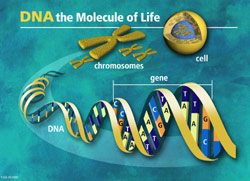
In the center of the cell is the nucleolus composed of deoxyribo-nucleic acid (DNA), protein and ribonucleic acid (RNA). DNA combined with proteins is organized into structural units called chromosomes, which usually occur in identical pairs. The DNA molecule form the infrastructure in each chromosome and is a single, very long, highly coiled molecule subdivided into functional units called genes. A gene occupies a certain place on the chromosome and contains the coded instructions that determine the inheritance of a particular characteristic or group passed from one generation to the next. The Chromosomes contain the information needed to build an identical working cell.Cells serve two functions to provide a framework to support life and to make copies of themselves. They do this by having a communication system between the nucleolus and the rest of the cell. Inside the nucleolus is located all the information need to function, replicate and repair the cell. Only now is this incredibly complex system of cell communication becoming known.
In the same way a software program uses binary code, combining 0 and 1 to communicate programs throughout a computer system the cells uses the combination of four nitrogen-containing bases to communicate inside the cell. (Adenine (A), Thymine (T), Cytosine (C) and Guanine (G).Molecular biologists classify it as equivalent to a written language but not by analogy.
The statistical structure of any printed language ranges through letter and frequencies, diagrams, trigrams word frequencies, etc., spelling rules, grammar and so forth and therefore can be represented by a Markov process given the states of the system…..It is important to understand that we are not reasoning by analogy. The sequence hypothesis applies directly to the protein and the genetic text as well as to written language and therefore the treatment is mathematically identical.[1]
The cell has a language of its own, fully equipped with rules that govern how it communicates. This cellular communication system has been shown to have a one-to-one correspondence with our own communication systems.
The genetic code is composed of four letters (Nucleotides), which are arranged into sixty-four words of three letters each (triplets or codons). These words are organized in sequence to produce sentences (Genes). Several related sentences are strung together and perform as paragraphs (Operons). Tens of thousands of paragraphs comprise chapters (Chromosomes), and a full set of chapters contain all the necessary information for a readable book (Organism).[2]
The possibility of life coming into existence on its own requires two elements time and probability.
David Foster illustrates the problem with a deck of 52 playing cards.
Specificity is the measure of the improbability of a pattern which actually occurs against a background of alternatives…Let us imagine that there is a pack of 52 cards well shuffled and lying face-downwards on a table. What are the chances of picking all the cards up in a correct suit, sequence starting with the Ace of Spades and working downwards and then through the other suits and finishing with the Two of Clubs?
Well, the chance of picking up the first card correctly is 1 in 52, the second 1 in 51, the third card 1 in 50, the fourth card 1 in 49 and so forth. So the chance of picking up the whole pack correctly is Factorial 52.
As one chance in… (About) 1068 this number is approaching that of all the atoms in the universe.
· Number of seconds back from now to the estimated date of the Big Bang is 4 x 10¹⁷ (1018)
· Number of atoms in the universe: 1080
· Number of photons in the universe: 1088
· Number of stars in the universe: 1022
· Number of wavelengths of light to traverse the universe 2 x 1033.16[3]
The astronomers Fred Hoyle and Chandra Wickramsinghe placed the probability that life would originate from non-life As one 10-40,000 and the probability of added complexity arising by mutations and natural selection very near this figure.[4]
To believe that life could have come from non-life would require an incredible amount of faith.
The information content of the brain expressed in bits is probably comparable to the total number of connections among the neurons—about a hundred trillion, 1014, bits. If written out in English, say, that information would fill some twenty million volumes, as many as in the world largest libraries. The equivalent of twenty million books is inside the heads of every one of us. The brain is a very big place in a small space[5]
When we examine the complexity of life and the improbability of life developing from non-life, we are forced to come to the conclusion that a Super-Intelligent Designer is the source for life.

DNA by Dr. Kent Hovind:
The DNA molecule in your body (the Deoxyribonucleic Acid) is the most complex molecule in the universe. The average person in this room has 50 trillion cells in their body. Each of those cells contains 46 chromosomes—except for the gammates, they’ve got 23. If you took all of the chromosomes out of your body, you would end up with about two tablespoons of chromosomes. That’s it. Extracting all of them from every cell in your body would give you about two tablespoons. But if you stretch them out, each one six or seven feet long (they are wound up like a tight little spring) if you stretched them out and tied them all together, one persons chromosomes would reach from the earth to the moon and back five million round trips. Coming out of one person's chromosomes. Pretty amazing don’t you think?!
How Complex is DNA?
And if you typed out this computer code you would find you’ve got enough code in your DNA, and it is more complex and contains more information than all of the computer programs ever written by man combined! Pretty amazing! And this unbelievably complex DNA code if you typed it all out, when you  got done typing you would have enough books to fill Grand Canyon forty times.
Anybody work with computers at all? Who works with computers around here? Anybody? Alright. I want to see you get forty Grand Canyons full of books. More than ever has been written or printed or copied in the history of the world and I want you to condense it to software. You can use CD ROM, PK Zip, or SyQuest. I don’t care what you use, but when you are done it must fit into two tablespoons. My Heavenly Father did it! And it reproduces itself! Did you know you are a copy off a copy, off a copy, off a copy, off a copy, off a copy, off a copy, off a copy, off a copy, off a copy, off a copy of Adam? That’s pretty amazing don’t you think? I mean that is really amazing! King David said in Psalm 139, “I will praise Thee, for I am fearfully and wonderfully made.” He didn’t even have a microscope and he could figure it out! Today we ought to really be praising God. See, science should cause us to praise God. And the devil knows that, so he’s working awful hard to infiltrate science where it turns students away from God. The probability of just one DNA happening by chance. That’s a complex molecule. The chances of just one coming together in random order has been calculated to be one times 10 to the 119,000th power. That’s a big number! That would have 119,000 zero’s behind it!
Chance DNA
One professor told me in a debate—he said, “Now, Mr. Hovind, if we can just get one DNA by chance, evolution can take it from there.” Well, there are your odds against getting your first one. But I’ll give you one. I’ll give you two! I’m going to be nice. I’m going to let him start with two DNA.
I did some research on this, folks. I decided the more chromosomes you have, the more complex you must be because it is the most complex molecule in the universe; and so I arranged a bunch of animals and plants in order based upon the number of chromosomes they had. I discovered that penicillin has two chromosomes. Fruit flies have eight. There are a few missing links in there three, four, five, six, seven.  I don’t know where they went, but I do believe from this research that I could prove that penicillin slowly evolved into fruit flies. And then over billions of years, they got more chromosomes someplace and turned into either a housefly or a tomato. (They are twins, you know! Pretty tough to tell the difference.) They both have 12 chromosomes. And then very slowly over billions of years we got more chromosomes and became a pea. And then over billions of years they got two more chromosomes and turned into a bee. Pretty close, now: bee—pea, see the similarities? And then very slowly became lettuce. And then a carrot. And when we got to 22 chromosomes a miracle took place. Did you know the possum, the redwood tree and the kidney bean all have 22 chromosomes? Identical triplets. See, that’s a possum; that’s the tree and kidney bean. Hey! Got them right! Look
  at that! The average scientist can’t tell the difference. They’ve got 22 chromosomes—all three of them. “Let’s see: we’ve got tree, possum, kidney bean and huh, which one is which? I don’t know.” Very slowly over millions of years we got enough chromosomes to become a human. Here we are folks: we have forty-six. And if we can just get two more we are going to be a tobacco plant! I know some that already smell like it! Sometimes I’ll get on the elevator and I’ll say,”(sniff) Man, you’re evolving! You are way ahead of me! How did you do that?” And then some day in the far distant future, we may have enough chromosomes to be a turkey—eighty-two. And some day in the way far distant future (now, this won’t happen in my lifetime but maybe star date 349572), we might have enough chromosomes to be a fern! I was in a church a few years ago and a lady came to me after church, stuck out her hand and said, “Mr. Hovind, I’m Fern!” I shook hands with that hand right there. I’ll never wash it again!
Why don’t they teach the kids about the chromosome number as proof for evolution? I’ll tell you why: because it goes totally against the theory. You won’t find that mentioned anyplace! Those are facts, folks! Chromosome number does not prove evolution. That’s all a farce, of course. And evolution itself is a farce.